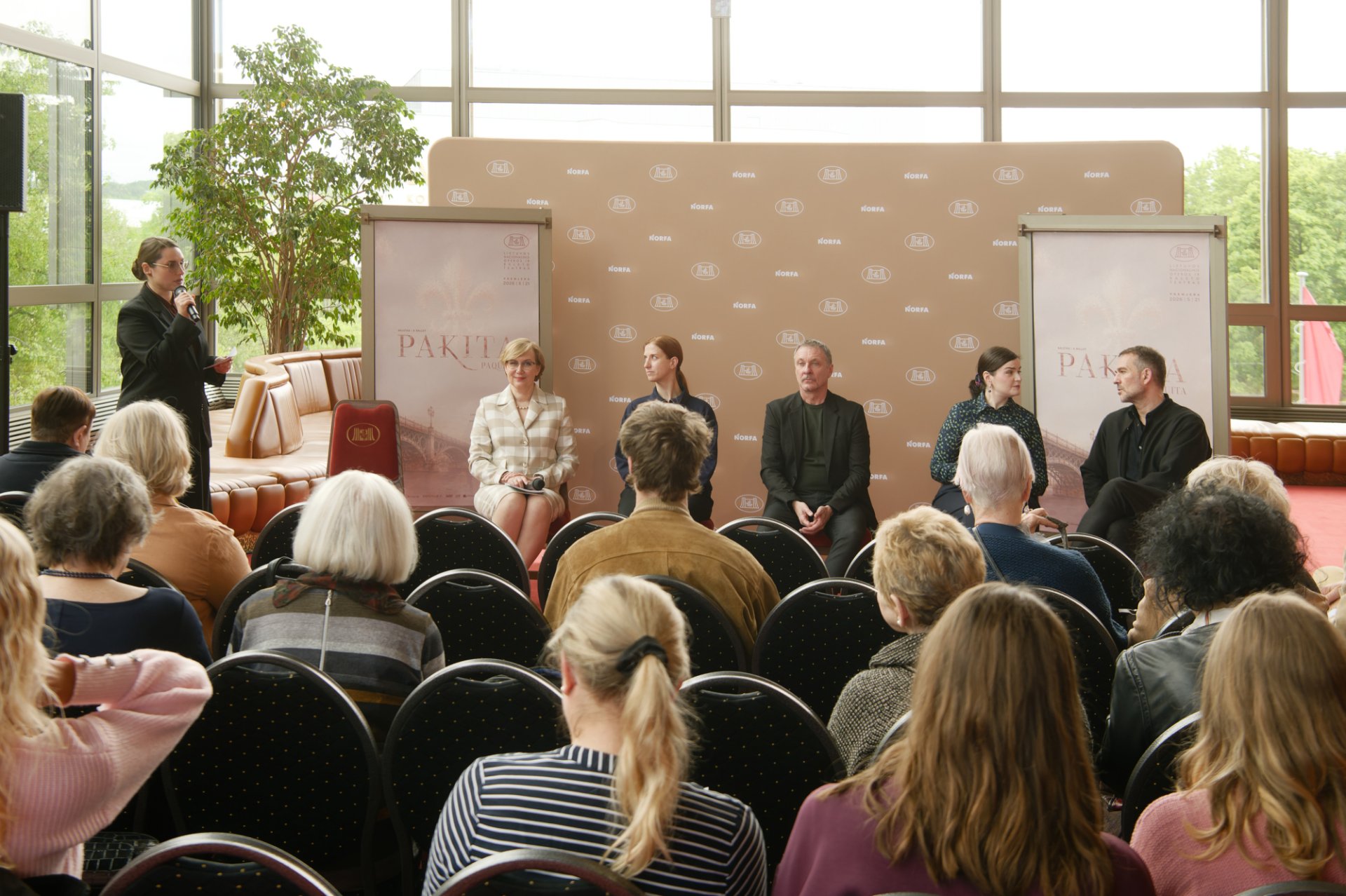
The Lithuanian National Opera and Ballet Theatre (LNOBT) welcomes the classical ballet "Paquita", the production of which was created in Vilnius by the famous French choreographer Manuel Legris.
"The ballet "Paquita" is the last grand premiere of the LNOBT season dedicated to the 100th anniversary of Lithuanian ballet. This is a production that is like a mastery exam for ballet dancers, because M. Legris's choreography is, above all, quality and precision. I am extremely happy that our company has passed this mastery exam with honours. I believe that "Paquita" will live in the theatre’s repertoire for a very long time," – says Laima Vilimienė, General Manager of LNOBT.
Liveliness will captivate the audience
The premiere choreographer, M. Legris, a former long-time principal of the Paris National Opera Ballet, transferred his "Le Corsaire" from the Vienna State Opera to the LNOBT in 2018. Meanwhile, "Paquita" is the first classical ballet created by M. Legris specifically for the Lithuanian company.
"First of all, "Paquita" is a historical ballet, which is extremely interesting for every choreographer to take on. My acquaintance with this ballet began from the position of a dancer, because I myself had to perform the role of Lucien in the production of choreographer Pierre Lacotte. When you have deeply immersed yourself in someone else's version, it is difficult to create something new and unique. However, I was helped by excellent colleagues: music director Maria Seletskaja and set and costume designer Jean-Marc Puissant, who themselves had previously danced the ballet and preserved the dance gene in themselves," – says M. Legris.
The choreographer notes that most ballet fans, when talking about "Paquita", first of all think of the Grand pas Classique – the final performance of the soloists of this ballet.
"Meanwhile, the entire "Paquita" is not often staged, although this ballet pulsates with beauty, passion, and simply lively dance, which should captivate the audience. In addition to the excellent LNOBT ballet soloists, 24 young dancers from the National M. K. Čiurlionis School of Arts will also participate in the performances," – emphasizes the premiere choreographer.
Historical context of the ballet
"Paquita" is set in Seville in the mid-nineteenth century. At that time, Queen Isabella II ruled Spain. She became queen thanks to a law changed by King Ferdinand VII, her father. However, the king's brother Charles V opposed this, and Spain was divided for a long time into two irreconcilable political camps: the Legalists, who supported Isabella II, and the Carlists, who supported Charles V.
The romantic story of the acquaintance of the beautiful dancer Paquita and the French colonel Lucien takes place against the backdrop of the intrigues woven in these camps, beginning with the solemn opening ceremony of the bridge named after Queen Isabel II. We will also see the aforementioned bridge in the ballet's scenography, created by the French theatre artist J.-M. Puissant.
“When it comes to the visual side of “Paquita”, it is important to understand that the events depicted in the ballet have a very clear historical reference – the opening ceremony of the bridge in Seville, attended by Queen Isabella II of Spain and Empress Eugenie of France. This allowed us to put together the design of the ballet very carefully, as it was possible to rely on historical visual sources from the mid-nineteenth century,” – says J.-M. Puissant, who is collaborating with choreographer M. Legris for the first time.
The score features nineteenth-century music
The premiere's music director and conductor, Maria Seletskaja, music director of the English National Ballet and principal conductor of the company's symphony orchestra, says that the nineteenth century will also be reflected in the newly rearranged ballet score.
"The current score of "Paquita" is made up of music by as many as six different composers. Since the instrumentation of their works differed, we had to unify them, bringing them closer to the extremely thick and intense orchestral sound of the Grand pas classique. I can assure you that we tried to do this while maintaining the utmost respect for all the authors of the music," – says the conductor, who previously danced the popular Grand pas classique on stage as a ballet dancer herself.
The premiere of "Paquita" on the LNOBT stage shall be presented on Thursday, the evening of 21 May. The audience will be able to admire the magic of classical ballet until 30 May.